Tuesday, October 2, 2012

Jared Shoupe Pickles

Shaun O'Sullivan also commented on his photo.

Shaun O'Sullivan Here ya go. This recipe was created by Jared Shoupe and passed along to me: 

Ingredients

3# pickling cucumber
12oz pale hoppy beer
1/4 cup water
2 cups distilled white vinegar
1/2 cup sugar
1 tablespoon salt
1 tablespoon whole peppercorn
1 tablespoon mustard seed
2 cloves garlic smashed
1/2 oz whole cascade hops

Process

Put beer, water, vinegar, salt, sugar, garlic in a saucepan. Heat med high stirring to dissolve sugar and salt. After dissolved, let heat to simmer,turn off heat. Disperse all other ingredients into sanitized (boil all parts) mason jars evenly (it should all fit in a 64oz jar, two 32oz, etc.). Let brining liquid cool 15 minutes and pour over cucumbers with hops and remaining pickling spices (peppercorns, mustard seed and smashed garlic). Seal jars and refrigerate immediately, the cooling will seal the jar. If cucumbers are sliced, they should be ready in a week. Whole will take 2 weeks, but have better crunch.

Tuesday, September 18, 2012

Russian River, Alpine, Hair of the Dog now available online at Windy City Liquor

Russian River, Alpine, Hair of the Dog now available online at Windy City Liquor:
russian river supplication label
Supporter Post:
BeerPulse just brought on Southern California-based Windy City Liquor as a new supporter. Like others we feature on here occasionally, Windy City can ship beer to the majority of states here in the U.S..
Take a peek at a) some of our handpicked selections below, b) new beer arrivals or c) full inventory (note: may be missing some new arrivals so check those, too). Their site is brand-new and a work-in-progress so, for now, you can place an order by calling the store manager, Julian, or emailing him. Shipping info and contact details here.
Top 10 New/Returning Beers
Rank Top Beer ABV Price RB Score
10 Shipyard Pugsleys Smashed Pumpkin 9% $8.99 89/94
9 Dogfish Head Punkin Ale 7% $11.99 90/95
8 Stone 16th Anniversary 10% $6.99 98/90
7 Uinta Oak Jacked Imperial Pumpkin 95/98
6 Deschutes Black Butte XXIV 11% $13.99 99/94
5 Jolly Pumpkin Sobre Humano Palena ole 6% $23.99 99/94
4 Mikkeller/Brew Dog I Hardcore You 9.50% $7.49 99/97
3 Port Brewing Hop 15 10% $7.99 100/99
2 Alpine Duet 7% $9.99 100/100
1 Russian River Pliny the Elder 8% $6.99 100/100

Legend: WR = “RateBeer World Ranking” / RB = “RateBeer”
Top 25 Overall Beers
Rank Top Beer Buy beer from… WR RB Score
25 Deschutes/ Hair of the Dog Collage Conflux Series #1 11.60% $14.99 99/97
24 The Bruery Fruet 16% $32.99 99/98
23 Logsdon Seizoen Bretta 8% $11.99 99/98
22 Anchorage Bitter Monk 9% $15.99 99/98
21 Green Flash West Coast IPA 7% $4.99 99/100
20 Allagash Interlude 2008 9.50% $24.99 99/99
19 Dogfish Head 90 Minute Double IPA 9% $11.99 100/99
18 Firestone Double Jack Double IPA 9.50% $7.99 100/99
17 Jolly Pumpkin Luciernaga the Firefly 6.50% $16.99 99/100
16 The Lost Abbey Framboise 7.00% $16.99 100/99
15 Gouden Carolus Cuvee Van De Keizer Blue 11% $13.99 100/100
14 Mikkeller Beer Geek Breakfast 7.50% $11.99 100/100
13 Struise Pannepot 10% $7.99 100/100
12 Ballast Point Sculpin 7% $7.99 100/100
11 Port Brewing Older Viscosity (2009) 12% $16.99 100/100
10 Hair of the Dog Adam 10% $4.99 100/100
9 Alpine Duet 7% $9.99 100/100
8 Russian River Consecration Batch 008 10% $14.99 50 100/99
7 St. Bernardus Abt 12 10% $13.99 46 100/99
6 Russian River Supplication 7% $13.99 44 100/100
5 Great Divide Oak Aged Yeti Imperial Stout 9.50% $9.99 36 100/99
4 Stone Imperial Russian Stout 10.50% $6.49 30 100/99
3 Russian River Pliny the Elder 8% $6.99 19 100/100
2 Rochefort Trappistes 10 11.30% $9.99 9 100/100
1 Ale Smith Speedway Stout 12% $11.99 6 100/100
New Arrivals/In-store Tasting Updates:
Follow @windycityliquor

Disclaimer:
BeerPulse takes no responsibility for orders and merely acts as a conduit of information. You must be 21 to order alcohol in the U.S..
sponsored-post-disclaimer


Friday, August 3, 2012

Notes for my next possible brew: Perspective on Brewing Beliner Weisse Style Beer

Perspective on Brewing Beliner Weisse Style Beer:
Presentation by Jess Caudill of Wyeast Laboratories during National Homebrewers Conference 2012. If you are interested at all in this beer style, check this out!
Thanks to Wyeast and the American Homebrewers Association for allowing Northern Brewer to document some of this year’s presentations.

Wednesday, February 22, 2012

Brewday #016 Belgian Golden Strong

Sour

Tart Cherries 9# for 5 gallons @ 3# from garden and 6# from jars, per Lennie

Tuba - Coconut wine

Brewday #017 Flander's Red Base beer

10 gallons = 7.5 gallon yield,
OG = 1.033 unexplained poor efficiency aimed for 1.044
Brewdays requiring relocation of equipment to remote sites for me, will be in the history books from now on.

Thursday, February 16, 2012

SOUR NOTES

sour notes with Jen Talley

Use great quality Malt (Weyermann)
15-20% Munich Malt
Mash 156°-158°
Don't use Carapils
don't bottle a "sick" beer
When topping off, don't pour on top of the pelical, break it and use a
tube to pour under the pelical

on another note, "Dry-Hop the shit out of that!"

http://thebrewingnetwork.com/BN-Army-Blog/Post-Session-01-08-12-Redhook-Brewing-and-the-BNAs

Tuesday, February 7, 2012

I LOVE RECEIVING EMAILS LIKE THIS!

Boulevard Brewing - 11:30am - VIP Tour and Luncheon: Secure your spot for an exclusive VIP tour and luncheon with Boulevard’s brewmaster, Steven Pauwels, and the Beer Kitchen as they share their inspired pairings. The tour will begin from our Tasting Room promptly at 11:30am with the meal concluding at approximately 1:30 pm. Tickets for this event, which include the tour and three-course lunch, are $42 each including tax.

Hello  BYOBKC!
You are invited to the following event:
EVENT TO BE HELD AT THE FOLLOWING TIME, DATE, AND LOCATION:
Attend Event
Feb 24, 2012 
11:30 AM - 1:30 PM
Boulevard Brewing Company
2501 Southwest Boulevard
Kansas City, MO 64108
View Map
Your event password is: ***********
Event registration is only by invitation with the provided password. Register with your email address and the password above to attend this event.

A power lunch for your taste buds. Congratulations, you've WON the lottery.  The Boulevard Brewmaster luncheon lottery that is. Act fast to secure your spot as seating is limited for this event. Boulevard is once again teaming up with local...
Read More 

We hope you can make it!

Cheers,
Boulevard Brewing Co. 


Boulevard Brewing - 11:30am - VIP Tour and Luncheon: Secure your spot for an exclusive VIP tour and luncheon with Boulevard’s brewmaster, Steven Pauwels, and the Beer Kitchen as they share their inspired pairings. The tour will begin from our Tasting Room promptly at 11:30am with the meal concluding at approximately 1:30 pm. Tickets for this event, which include the tour and three-course lunch, are $42 each including tax.

Thursday, October 20, 2011

Java vs Java

2011 vs 2010

2011 Bold French Roast Coffee
2010 Coffee was just about all gone

I don't recommend aging these, the beer holds up but the profile is
lost. It maybe best to have these a few months later, say
Jan/Feb/March.

Wednesday, October 12, 2011

Hitachino Espresso Stout

yum, roasty, similiar to Fouunder's Breakfast stout

Weyermann Introduces Heirloom And Terroir Malts

This is awesome! I can't wait to try some Abbey Malt® in a nice big quad! I wonder how available this will be for homebrewers.


Sent to you by J via Google Reader:


via Brewbound.com by Press Release on 10/11/11

Wyermann Malting FloorThere was once a simpler time — before modern transportation, mechanized agriculture, and factory foods — when every dish and every beverage, including beer, that mankind put on the table at mealtime was "craft," that is, made by hand; and it came from local fields instead of distant food processing plants. The beers made until only about a century or two ago, therefore, were always a reflection of the flavors of their locales — their terroir, to borrow a term from the world of wine. It was simply that difference in the character of local ingredients that gave rise to the many beer styles we still treasure today.

Until recently, however, if a brewer sought to reproduce a traditional, localized beer style authentically he or she could learn about the process from old texts, but generally could not obtain the old-style malts called for by these texts. To fill this void, the Weyermann® Malting Company of Bamberg, Germany, has been developing a new portfolio of "heirloom" and "terroir" malts, some of which go back in time, while others come from major brew cultures, and some do both. These new malts are designed to meet a growing interest by sophisticated consumers in authentic traditional beers styles. They also open up new and creative avenues for brewers to engage in exciting new experimentation. The new Weyermann® heirloom and terroir malts are:

  • Weyermann® deep-amber, aromatic Abbey Malt® (16 – 19 °L), an excellent highly friable Belgian-style honey malt with plenty of malty residual sweetness, excellently suited for Belgian monastery brews as well as lambics and fruit beers
  • Weyermann® honey-colored Carabelge® (11.7 – 15.5 °L), a perfect caramel malt for Belgian Dubbel and Oud Bruin, for instance
  • Weyermann® "Grätzer/Grodziskie" Oak-Smoked Pale Wheat Malt (2.3 – 3.9 °L), specifically designed for traditional northeastern European wheat ales made from 100 percent wheat malt
  • Weyermann® Bohemian Pilsner Malt (1.7 – 2.1 °L) for modern Czech Pilsners
  • Weyermann® hand-crafted floor-malted Bohemian Pilsner Malt (1.6 – 2.3 °L) for classic Czech Pilsners
  • Weyermann® hand-crafted floor-malted Bohemian Dark Malt (5 – 8 °L), well suited for classic Czech Dunkel lagers as well as dark bock biers
  • Weyermann® hand-crafted floor-malted Bohemian Pale Wheat Malt (1.6 – 2.3 °L) for traditional Czech wheat ales, but also well suited for Bavarian Hefeweizens, Belgian Wits, Weizenbocks, and wheat wines

These new malts from Weyermann® take their place next to other, well established Weyermann® malts with special heirloom and terroir characteristics, such as the venerable Rauchmalz for Bamberg-style smoked lagers; the unusual Dinkelmalz (a dehusked spelt malt made from Triticum spelta, an heirloom hard-kernel wheat variety) for old-fashioned southwestern German spelt ales; Rye Malt, Cararye®, and Chocolate Rye Malt for different variations of the German Roggenbier ale of medieval lineage; Caraaroma®, which is wellsuited for Belgian recipes calling for dark crystal malts with rich roasted caramel flavors; Melanoidin Malt, which is a perfect choice for Belgian-style biscuit malts; well modified Pale Ale Malt for English-style ales; Vienna Malt for Vienna Lagers; and Munich Malt and Caramunich® for many of the Bavarian lagers.

Brewing heirloom and terror beers authentically is all about distinct flavors, which means that all the ingredients must impart the soil, water, air, and climate characteristics of the locale where the style once emerged. For such beers, a modern brewer can now easily select the required hops from a dozen or so traditional growing areas around the world; can purchase appropriate pure yeast strains from many suppliers; and can deconstruct the local water and rebuild it to another location's specifications. The flavor and aroma of the malt, too, must be locale- and period-specific, because it is an agricultural product after all — just as grapes are for wine-making.

It is often a matter of debate how, exactly, beers from centuries ago really tasted, but we do know that floor-malted grains, for instance, that are hand-turned the old-fashioned, labor intensive way on the germination floor, give brews a particularly earthy, deep, rich, and satisfying aroma. Another component in making authentic heirloom and terroir malts is the careful selection of cultivars. The Weyermann® Bohemian Pilsner Malt, for example, is produced only from the Hanka barley variety, while the Weyermann® floor-malted Bohemian Pilsner Malt is produced only from Bojos or Tolar. These three varieties have great authenticity value because they are genetic descendants of the mid-19th-century Czech variety Haná, which also known as "Old-Haná Agro-Ecotype." Haná was the barley in the first Pilsner mash, in 1842, and it has since become the foundation land race for hundreds of top quality brewing barley varieties cultivated throughout the world today.

As craft beer-makers have become the artisanal guardians of fresh and wholesome brews, full of personality and flavor, made from the best ingredients, and mostly for local markets, the new Weyermann® portfolio of heirloom and terroir malts give better-beer brewers the expanded means to satisfy their consumers' yearnings for authentic beverages across time and cultures.


Things you can do from here:


Weyermann Introduces Heirloom And Terroir Malts

This is awesome! I can't wait to try some Abbey Malt® in a nice big quad! I wonder how available this will be for homebrewers.


Sent to you by J via Google Reader:


via Brewbound.com by Press Release on 10/11/11

Wyermann Malting FloorThere was once a simpler time — before modern transportation, mechanized agriculture, and factory foods — when every dish and every beverage, including beer, that mankind put on the table at mealtime was "craft," that is, made by hand; and it came from local fields instead of distant food processing plants. The beers made until only about a century or two ago, therefore, were always a reflection of the flavors of their locales — their terroir, to borrow a term from the world of wine. It was simply that difference in the character of local ingredients that gave rise to the many beer styles we still treasure today.

Until recently, however, if a brewer sought to reproduce a traditional, localized beer style authentically he or she could learn about the process from old texts, but generally could not obtain the old-style malts called for by these texts. To fill this void, the Weyermann® Malting Company of Bamberg, Germany, has been developing a new portfolio of "heirloom" and "terroir" malts, some of which go back in time, while others come from major brew cultures, and some do both. These new malts are designed to meet a growing interest by sophisticated consumers in authentic traditional beers styles. They also open up new and creative avenues for brewers to engage in exciting new experimentation. The new Weyermann® heirloom and terroir malts are:

  • Weyermann® deep-amber, aromatic Abbey Malt® (16 – 19 °L), an excellent highly friable Belgian-style honey malt with plenty of malty residual sweetness, excellently suited for Belgian monastery brews as well as lambics and fruit beers
  • Weyermann® honey-colored Carabelge® (11.7 – 15.5 °L), a perfect caramel malt for Belgian Dubbel and Oud Bruin, for instance
  • Weyermann® "Grätzer/Grodziskie" Oak-Smoked Pale Wheat Malt (2.3 – 3.9 °L), specifically designed for traditional northeastern European wheat ales made from 100 percent wheat malt
  • Weyermann® Bohemian Pilsner Malt (1.7 – 2.1 °L) for modern Czech Pilsners
  • Weyermann® hand-crafted floor-malted Bohemian Pilsner Malt (1.6 – 2.3 °L) for classic Czech Pilsners
  • Weyermann® hand-crafted floor-malted Bohemian Dark Malt (5 – 8 °L), well suited for classic Czech Dunkel lagers as well as dark bock biers
  • Weyermann® hand-crafted floor-malted Bohemian Pale Wheat Malt (1.6 – 2.3 °L) for traditional Czech wheat ales, but also well suited for Bavarian Hefeweizens, Belgian Wits, Weizenbocks, and wheat wines

These new malts from Weyermann® take their place next to other, well established Weyermann® malts with special heirloom and terroir characteristics, such as the venerable Rauchmalz for Bamberg-style smoked lagers; the unusual Dinkelmalz (a dehusked spelt malt made from Triticum spelta, an heirloom hard-kernel wheat variety) for old-fashioned southwestern German spelt ales; Rye Malt, Cararye®, and Chocolate Rye Malt for different variations of the German Roggenbier ale of medieval lineage; Caraaroma®, which is wellsuited for Belgian recipes calling for dark crystal malts with rich roasted caramel flavors; Melanoidin Malt, which is a perfect choice for Belgian-style biscuit malts; well modified Pale Ale Malt for English-style ales; Vienna Malt for Vienna Lagers; and Munich Malt and Caramunich® for many of the Bavarian lagers.

Brewing heirloom and terror beers authentically is all about distinct flavors, which means that all the ingredients must impart the soil, water, air, and climate characteristics of the locale where the style once emerged. For such beers, a modern brewer can now easily select the required hops from a dozen or so traditional growing areas around the world; can purchase appropriate pure yeast strains from many suppliers; and can deconstruct the local water and rebuild it to another location's specifications. The flavor and aroma of the malt, too, must be locale- and period-specific, because it is an agricultural product after all — just as grapes are for wine-making.

It is often a matter of debate how, exactly, beers from centuries ago really tasted, but we do know that floor-malted grains, for instance, that are hand-turned the old-fashioned, labor intensive way on the germination floor, give brews a particularly earthy, deep, rich, and satisfying aroma. Another component in making authentic heirloom and terroir malts is the careful selection of cultivars. The Weyermann® Bohemian Pilsner Malt, for example, is produced only from the Hanka barley variety, while the Weyermann® floor-malted Bohemian Pilsner Malt is produced only from Bojos or Tolar. These three varieties have great authenticity value because they are genetic descendants of the mid-19th-century Czech variety Haná, which also known as "Old-Haná Agro-Ecotype." Haná was the barley in the first Pilsner mash, in 1842, and it has since become the foundation land race for hundreds of top quality brewing barley varieties cultivated throughout the world today.

As craft beer-makers have become the artisanal guardians of fresh and wholesome brews, full of personality and flavor, made from the best ingredients, and mostly for local markets, the new Weyermann® portfolio of heirloom and terroir malts give better-beer brewers the expanded means to satisfy their consumers' yearnings for authentic beverages across time and cultures.


Things you can do from here:


Tuesday, October 4, 2011

SHOW ME YOUR CONES

I ran across this today and it just seemed like a better idea than strapping one of those plastic conicals to the wall. That just scares me. However, I'm on the fence about the actual material used.


http://www.homebrewtalk.com/f51/15-gallon-fermentor-table-build-223291/index12.html

http://www.tank-depot.com/browse.aspx?id=49

Sunday, September 18, 2011

2011


Great Porter with green tomato flavor 4.5/5

too syrupy maybe a 2/5

Loved this by Jolly Pumpkin 5/5

This is what fruit beers should taste like! light fruit, great flavor 5/5

storage

not big on the Anise, but it was decent 3.5/5


Open bar at CSB for KC Gents! thanks Jon and the CSB team!

If only... we did get some Utopias but then I became more interested when I saw this!

Best Beer Board Ever

Sent to you by J via Google Reader:


Spotted in Bailey's Taproom in Portland, this has to be the best beer board ever. It contains lots of information about each beer including colour of beer, style of glass used and how much beer is left in each keg.

Saturday, September 10, 2011

Las Vegas

In general, I found Vegas to be miserably HOT during the day, smokey all over and rude. Every drip of sweat I felt seeping from my body seamed to evaporate before it ever formed on my skin. Every corner was filled with 5+ card flippers (you know what I mean if you've been there) and well, lets just bunch the rest in to "lots of stuff to see". While on the strip, good beer was next to nothing in supply, we did find a boutique shop on the second floor of the Cosmopolitan (Douche Bag Central) which sold Chimay blue and Dogfish Head 90, score! I got a 90 and my wife decided she wanted a Chimay. You can manage a $5 90 minute from a bottle but not a $8 Chimay blue. I decided she required a glass, so my best option seemed to be to purchase a cognac glass for her so that she could properly enjoy her monk brewed beverage. If you're in a pinch, that's what I would recommend. We made a stop there every trip down the strip (both directions). The Cabo Waborita's were incredible as well, I think I managed 4 during our 4 day visit.

There were two places I heard about to visit for beer retail while in Vegas. Khoury's which I heard was a bit small but didn't verify Total Wine & More which was conveniently located on the way back from Hoover Dam. Total had The BRUERY, DOGFISHHEAD and MAUI which was all I could fit in to my suitcase for the trip home. TOTAL was worth the stop and had plenty to choose from.


Obviously, some goodies for the "Wifey" as well. I know we can get Cherish here in town but I haven't seen Raspberry and she wanted to bring some back. Why not.


Some good info I needed when packing our bags... SHIPPING WEIGHT

12oz can = .8lbs

12oz bottle = 1.3lbs

22oz bomber = 3lbs

750ml champagne style bottle = 4lbs

I owe Vegas one more stop, to see the Grand Canyon for a photo trip. It will be after the children are big enough that they can't fall asleep and leave me to carry them the rest of the way to any destination. See you in no less than 10 years Vegas, anything sooner is too soon.

Monday, July 18, 2011

ACBW 2011

Going to wrap this week up with a Brewday for batch #13 Citra Pale Ale & #14 Tasty's highly talked about Janet's Brown (I've never tasted it and hope that my execution is successful) It will be my first double brew day but hopefully I can pull it off without staying up until midnight cleaning.

mead

http://www.stormthecastle.com/mead/mead-recipes.htm

Thursday, June 30, 2011

#015 Boulevard Brewery Tank 7

#015 Tank 7
Saison
Type: All GrainDate: 7/2/2011
Batch Size (fermenter): 5.00 galBrewer: Jeremiah
Boil Size: 4.57 galAsst Brewer: Boulevard Brewery - Steven Pauwels
Boil Time: 60 minEquipment: J's Single Tier Keg Brewery
End of Boil Volume 3.22 galBrewhouse Efficiency: 72.00 %
Final Bottling Volume: 5.00 galEst Mash Efficiency 73.4 %
Fermentation: Tank 7Taste Rating(out of 50): 30.0
Taste Notes:
Ingredients
Ingredients
AmtNameType#%/IBU
9 lbs 7.2 ozPilsner (2 Row) Bel (2.0 SRM)Grain169.7 %
2 lbs 11.2 ozCorn, Flaked (1.3 SRM)Grain219.9 %
1 lbs 6.4 ozWhite Wheat Malt (2.4 SRM)Grain310.3 %
0.94 ozMagnum [16.00 %] - Boil 60.0 minHop438.7 IBUs
1.0 pkgBelgian Abbey II (Wyeast Labs #1762) [124.21 ml]Yeast5-
Beer Profile
Est Original Gravity: 1.072 SGMeasured Original Gravity: 1.046 SG
Est Final Gravity: 1.016 SGMeasured Final Gravity: 1.010 SG
Estimated Alcohol by Vol: 7.4 %Actual Alcohol by Vol: 4.7 %
Bitterness: 38.7 IBUsCalories: 151.6 kcal/12oz
Est Color: 4.5 SRM
Mash Profile
Mash Name: Single Infusion, Medium BodyTotal Grain Weight: 13 lbs 8.8 oz
Sparge Water: 0.09 galGrain Temperature: 72.0 F
Sparge Temperature: 168.0 FTun Temperature: 72.0 F
Adjust Temp for Equipment: FALSEMash PH: 5.20
Mash Steps
NameDescriptionStep TemperatureStep Time
Mash InAdd 16.94 qt of water at 163.7 F152.0 F60 min
Mash OutAdd 9.48 qt of water at 200.7 F168.0 F10 min
Sparge Step: Fly sparge with 0.09 gal water at 168.0 F
Mash Notes: Simple single infusion mash for use with most modern well modified grains (about 95% of the time).
Carbonation and Storage
Carbonation Type: KegVolumes of CO2: 2.6
Pressure/Weight: 16.06 PSICarbonation Used: Keg with 16.06 PSI
Keg/Bottling Temperature: 45.0 FAge for: 7.00 days
Fermentation: Tank 7Storage Temperature: 65.0 F
Notes
Created with BeerSmith

Wednesday, June 22, 2011

Flavor Extracts for Beer


AHA Pimp-My-System


Pimp my system: Bryan's Homebrew System

Pimp my system: Bryan's Homebrew System

Bryan has gone through a tremendous amount of time and effort to build the brewery of his dreams (at least for now)! It's pretty amazing what someone with a lot of passion can accomplish in only a few years with hard work, dirty hands and a vision. Here's Bryan's story:


Well this obsession all started out in the early 2000's when I got re-gifted a Mr. Beer kit that my dad had got as a present. Now what you don't know about me is that I take everything to the extreme. Why? I hate following the norm. Up until the first batches with Mr. Beer, I was a 21yr old beer drinker who didn't really like beer. It was such a fun and new experience, and I remember reading the instructions literally for days before I brewed. I remember watching the Mr. Beer keg churn for a few days, and just being in awe of what was going on. I will never forget bottling that first batch; it seemed like ages ago it made this monstrosity.

My attitude towards beer changed the day I drank my first homebrewed beer. I didn't particularly LOVE this beer I made, but I made it and that was just plain awesome. It also opened my eyes to beers other than the typical light American lagers. I brewed about 5 of the kits, before I realized they all kind of tasted the same. I did some internet research on Mr. Beer and brewing alternatives, and to my surprise there were two major players in the homebrew game right here in Minnesota (Midwest Supplies, and Northern Brewer). Since Midwest Supplies was closer to me I decided to go there and see what it was all about. Upon walking in I was blown away by all the stuff that was there (I had never seen or heard of about 95% of it). I told them what I had, and what I was experiencing. Let's just say I left Midwest about $600 poorer that day, with visions of making the best beer in the world.  I now had a ton of equipment, and my first real extract kit, an Irish Red. I once again read the instructions over until I could recite them. I brewed that first batch, and in what seemed like an eternity passed, finally got to have a taste. I heard choirs singing and the earth stood still. This beer was the best beer I have ever had! I only did one batch of extract, because of my extreme nature kicked into high gear.

I went back to Midwest about a month later, and said I want to make the best beer possible and how I would do it. All grain was what was brought up, along with lagers, and once again I left Midwest with a lot less money. I started acquiring parts to make a brew system, because I was told that the key to all grain is consistency. So in my head and still to this day consistency is what I am all about. I acquired a few sanke kegs, a cooler and re-purposed some fridge controllers to serve as my controllers for my system. I have always hated gas, so I knew this system would be all electric. I installed a 30amp dryer outlet in the garage and I was off. It took me a few weeks to put together the system (I had never brewed all grain before so I had to get the entire process down so I could put the system together properly). I finished the system and brewed my first all grain beer, a light lager ( hah!). It actually turned out really good, and I was hooked.

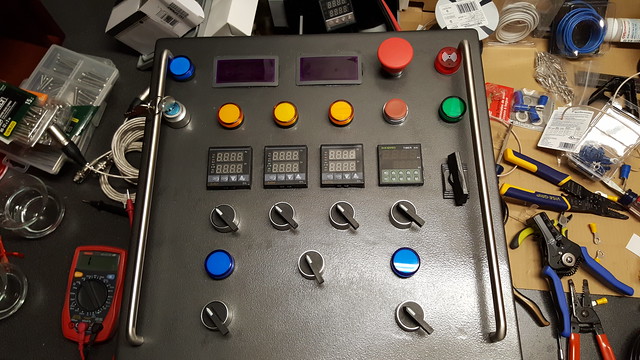
Let's fast forward to 2007, my wife and I moved to a new house and I had grand visions of a brewery in my basement, along with all the fixings. By this time I had a hundred or so batches of all grain under my belt, was kegging, lagering, making starters, making my own water from scratch, and competing. I started finishing my basement soon after we moved in, and had been eyeing the basement utility room for quite some time. I also wanted to upgrade my brewery with something. I had heard of a new brewery controller called BCS, from embedded control concepts here in MN. I spoke with them and it seemed like a great fit, and I was one of only a few trying it out. I instantly fell in love with it, allowing for a touch screen controller and web access. I was even able to control it from my phone. It was so cool being able to go to the store while mashing and check my temps.

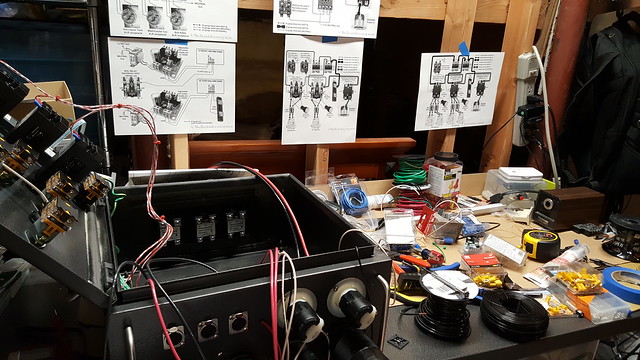
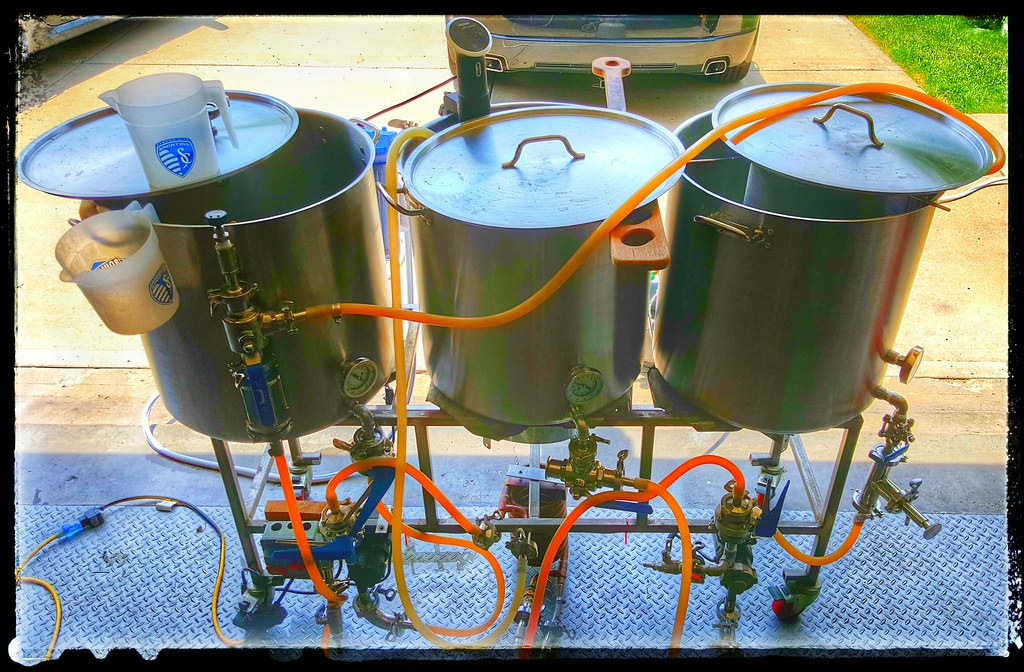
I brewed A LOT of beer with that system. The goal always was to sell our house in a few years, so I tried to make things not permanent, but comfortable for me. Well with the housing market in the dump, and failed attempts at selling our house we decided to stay. Since we decided to stay, that signaled the green light to my home brewery dream. So construction began! All of the home's ventilation, plumbing, and an electrical panel had to be moved (no easy task!). I am a DIY'er with just about everything, so I started the slow process of getting all the stuff out of the way so I could have a clear area.  I ran into a major hurdle when I had to move the sump pump (I could only move it so far without knocking out the whole floor - sadly it was actually an option) so I could add drains. I decided to just redo the brewing setup and go to use the traditional 3 vessel approach. After figuring all my walls and spaces I had come up with a finished space of 36" for a brewing system; time to get creative.  I had seen the schematics for a system called Brutus 20, and it really intrigued me. I wasn't aware of too many that had tried it; being that I push the envelope, and uncharted territory are my thing, I embraced it fully! I came up with some changes to the design so it would fit my criteria, which was:
•    100% stainless
•    Brew in the shortest amount of time (i.e. conserve power/electricty)
•    Hard plumbed and clean in place
•    As close to fully automated as possible (that consistency thing again)
•    As small of a foot print as possible
•    Electric
•    Being able to brew 5-20g batches
•    Heat exchanged recirculating mash system (HERMS)
•    A professional fit and finish

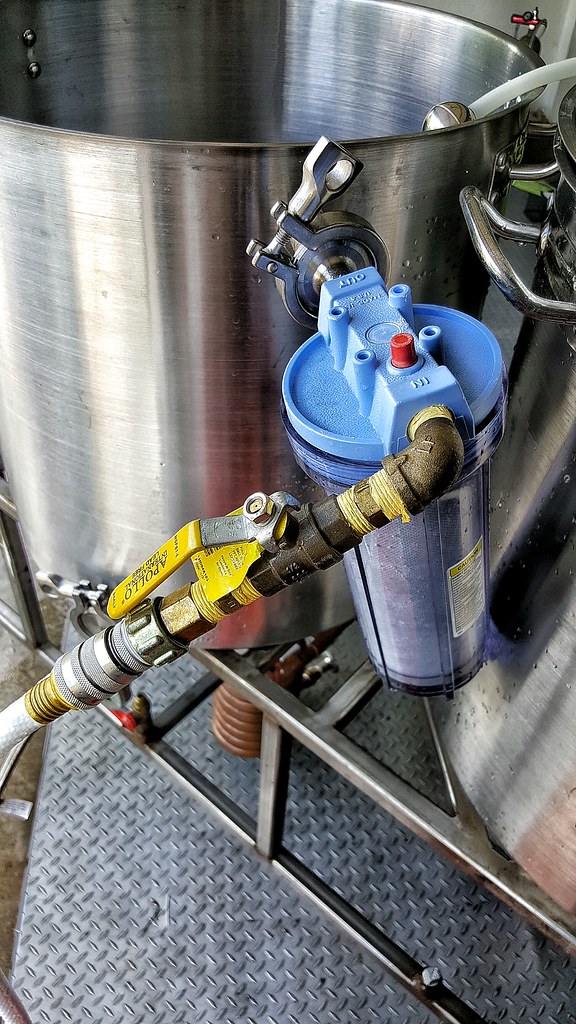
Blichman Tanks from AboveSo, I then set about to start sourcing parts, (eBay and restaurant equipment auctions was where I got most of the parts). By far the most expensive part of the build was the kettles - which are Blichmann Engineering Boilermaker 20 gallon pots. I got the Range hood and brew stand at an auction for under $10 (my personal favorite!) The rest of the hardware basically came from eBay, minus the electric ball valves, and the heart of the system the "Brewtroller", which is an amazing stand alone brewing control system for the do-it-yourselfer. In regards to the brewtroller, I want to thank all the guys that helped me with getting this thing running with the software, we were all kind of in un-charted territory and without them this would still be a pile of parts.

So for a parts list we have:
•    1-20gallon blichmann boilermaker HLT/Boilkettle with pressure sensor, sight glass, removable herms coil and heating elements
•    1-20gallon blichmann boilermaker Mash Tun with pressure sensor, sight glass, and a custom false bottom
•    100' of 304 ss tubing (50' for herms coil and 50' for the rest of the parts)
•    1 little giant 3-md-hc 1/12hp 750GPH pump (compared to march at 270gph)
•    12-12volt electric ball valves
•    2 pressure sensors
•    2 sight glasses
•    A Hot liquor tank stir motor to keep water at an even temp
•    1 brewtroller V3 controller
•    40plate plate chiller

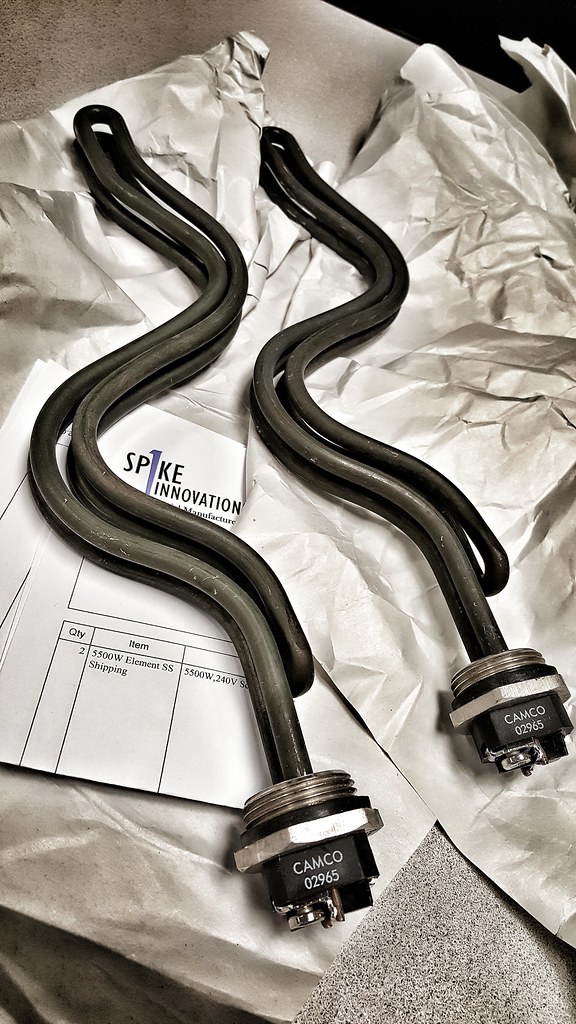
It also features 11k watts of heating power, hard plumbed hot and cold water, 2-20 gallon reverse osmosis storage tanks, a dedicated computer, 1200cfm range hood with makeup air, custom false bottom, dedicated 32" monitor, fully finished room with audio and video, and dedicated ip camera.

Plumbing under tanksHow I Brew a batch of beer:
The controller allows me to import recipes via BeerSmith to the controller, when that is done it knows all of the water volumes and temperatures needed for the brew session. Once imported, I have the option to brew now or set a time to start brewing.

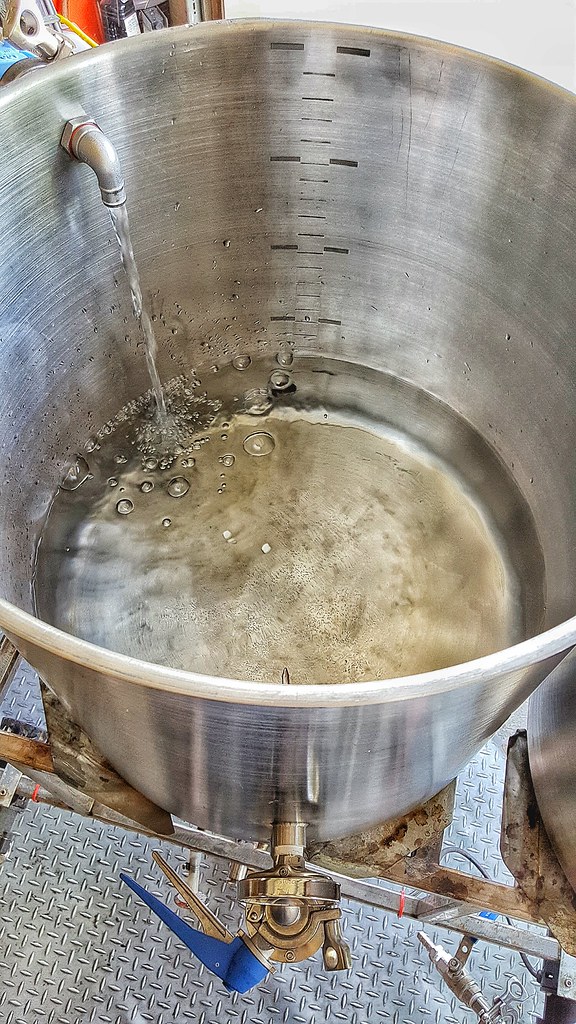
Once it's time to brew, the system turns on the fill valve from the reverse osmosis system opens, and in conjunction with the pressure sensor fills the hot liquor tank/boil kettle until it determines the proper water amount. When proper water amount is hit, reverse osmosis fill valve shuts, and the system automatically starts to heat the strike water. With 11k watts of power, I see about 9-11°F per minute raise on water heating, which is about 10-15 minutes from tap to strike. The stir motor is also on right now to aid in getting even temperatures.

Once strike temperature is met the system auto fills the mash tun with the proper amount of strike water, and prompts me to add the grain to proceed to the next step. I add the grains, stir well and hit the proceed button, and the controller takes it from here. I generally step mash all my beers.

While in "mash mode" the controller really shines (basically it uses a PID controller to maintain mash temperatures to .5 of a degree). Since I am using a HERMS based system the pump is always on recirculating the wort, but how my system differs is how it maintains its temperatures. If the temperature is low is will flow out the mash tun into the HERMS coil then back to the mash tun, if temperature is at or above temperature it will divert flow to bypass the HERMS to cool itself back down.

Once mashing is complete, I pump the remaining water in the hot liquor tank/boil kettle to the mash tun and do a 10 minute recirculation. That's the only "sparge" I can do with this system, but it nets about 70% efficiency. Once everything thing is homogenous in the mash tun, then the entire volume is then pumped to the hot liquor tank/boil kettle.

Once in the boil kettle, the controller will give it full power until the kettle hits 206 °F, then it starts throttling the elements to make sure no boil over will happen. Once the controller is past the boil over stage it will settle in at a power percentage (for me that's 40%) .  With 15 minutes left in the boil the controller will fire up the pump and do a sanitizing (with boiling wort) recirculation though the plate chiller. When boil timer expires, the controller kills the power to the elements, opens the cold water to the plate chiller and starts pumping chilled wort into the fermenter.

To clean my system I just scoop out grains, shop vac all the little bits, and open up all valves and flush with Hot tap water. Once pretty clean, I then dump in some PBW and it goes into its own cleaning cycle, which is almost exact to a brewing session.

Congratulations to you Bryan for sticking with your dream of building a brewery that you can be extremely proud of. It truely is inspiring to countless homebrewers accros the globe to one day create something as you have. Well done and keep brewing!

Wednesday, June 8, 2011

Beer Cooler Set-up

I think this is a great idea but will have to stick to a fridge in stead after all the issues I've heard about cycling and condensation. But it looks GREAT!


Sent to you by J via Google Reader:


via The Barley Blog by BarleyBlog on 6/8/11

A couple of weeks ago, before the real heat of a Virginia Summer had fully kicked in, I noticed that the temperature in the basement storeroom (where I house 150 or so bottles of beer) was higher than it should have been. Typically, in the hottest months the room averages 65° which isn't ideal, but manageable. This day, it was already hovering just below 70°. Knowing how hot the days ahead could get, this was definitely cause for alarm in my book.

The decision was made swiftly to purchase a chest freezer. I spent a good couple of days researching and pricing (there are a ton of options and models available), but ultimately settled on a 14 cubic foot GE that Home Depot had on sale (with free shipping no less) for $375. But the freezer wouldn't be fine as is. It would still get way too cold for my purposes. I don't want any "beercicles" on my hands.

Johnson Controls photo

It was recommended by my father-in-law that I pick up a Johnson Controls regulator from a home brewing shop. He uses one with his own chest freezer to maintain serving temperatures for his homebrews.

The device essentially overrides the freezer's own cooling mechanism by cutting power to the appliance when the desired temperature is attained. All you have to do is plug the freezer into the Johnson Controls and then plug the regulator into a suitable power supply. Pretty darn easy. I picked mine up at NorthernBrewer.com for about $65 (shipping included).

Everything finally came together late last night after a couple of hours for the freezer to reach a desired temperature of 53°. I spent about an hour transferring and organizing the bottles of beer. You'd be surprised how quickly the freezer filled up. I pretty much only have room for 2 more 750ml bottles and maybe a handful of 12oz bottles. The photo below was taken right before moving a series of vintages of Anchor Brewing's Our Special Ale from its cardboard box.

Chest freezer photo

With so little space left, it appears as though I'll have to maintain a system of rotation as I add more to the freezer — one in, one out sort of thing. It's not that bad of a problem to have, I suppose, but it just means that I may be drinking a bottle or two before I would ideally like to. At any rate, that's the new set-up. I think it is for the better. The temperature in the storeroom hit 73° yesterday afternoon when the freezer arrived.


Things you can do from here:


Wednesday, May 18, 2011

Monday, May 9, 2011

Sam Adams Longitude 48

drinking the Sam Adams Longitude 48

Ahtanum 

That's a lot a grapefruit! I may just try to source some for my next IPA. 


recommended usage: Finish Hops and Dry hops

Tuesday, May 3, 2011

88/200 beers at the Saucer

Brew Date
Firestone Walker Abacus 2011-05-02
Cantillon Iris 2007 2011-05-02
Struise Black Damnation III "Black Mes" 2011-05-02
Founders Curmudgeon 2011-04-23
Stone Imperial Russian Stout 2011-04-22
Stone Imperial Russian Stout Bourbon Barrel Aged 2008 2011-04-20
Stone Old Guardian Belgo 2011-04-20
Stone Double-Dry Hopped Sublimely Self-Righteous Ale 2011-04-20
Goose Island Dominique 2011-04-16
New Belgium Le Terroir 2011-04-16
Schlafly Coffee Stout 2011-03-31
North Coast Old Rasputin 2011-03-31
Crispin Flight 2011-03-31
Free State Stormwatch Ale 2011-03-31
Goose Island Pepe Nero 2011-03-31
Crispin Hard Apple Cider 2011-03-31
Schlafly Irish-Style Extra Stout 2011-03-20
Firestone Walker Double Jack 2011-03-20
Firestone Walker Abacus (BTL) 2011-03-20
Chimay Grand Reserve (BTL) 2011-03-13
Mikkeller 1000 IBU 2011-03-13
Maredsous Brune 2011-02-17
Ska Modus Hoperandi 2011-02-17
Cantillon Gueuze (BTL) 2011-02-13
Jolly Pumpkin Noel de Calabaza 2011-01-01
Breckenridge FS 15 Anniversary Ale V-2.0 2010-12-10
Sierra Nevada Celebration 2010-12-10
Bells Hell Hath No Fury 2010-12-10
Boulevard NutCracker 2010-12-06
Gulden Draak Vintage 2010-12-06
Delirium Noel 2010-12-06
Great Divide Fresh Hop 2010-11-05
Jolly Pumpkin La Parcela 2010-11-05
Lagunitas Undercover Investigation Shut-Down (BTL) 2010-11-04
Lagunitas A Little Sumpin Wild 2010-11-04
Goose Island Sophie 2010-09-26
Sierra Nevada Tumbler Autumn Brown Ale 2010-09-24
Founders Nemesis 2010 2010-09-24
Dieu du Ciel Peche Mortel 2010-09-12
Founders Black Biscuit 2010-09-12
Avery 17 2010-09-12
Dieu du Ciel Aphrodite 2010-07-30
Baltika 6 (BTL) 2010-06-27
Boulevard Smokestack Two Jokers 2010-06-27
Avery Maharaja 2010-06-27
Schlafly Grand Cru 2010-06-03
Schlafly American IPA 2010-06-03
Boulevard Pale Ale 2010-05-20
Odell Bourbon Barrel Stout 2010-05-18
Duvel (BTL) 2010-05-06
Big Sky Moose Drool 2010-05-06
Schlafly Trocken Hopfen Stopfen Marzen 2010-05-03
Blanche De Bruxelles 2010-04-17
Big Sky Cowboy Coffee Porter 2010-03-30
Big Sky Stone Thrower Scotch Ale 2010-03-30
Big Sky IPA (BTL) 2010-03-30
Founders Kentucky Breakfast Stout (BTL) 2010-03-21
Sam Adams Noble Pilsner 2010-03-21
Shiner Bock 2010-03-18
Founders Nemesis 2009 (BTL) 2010-03-18
Goose Island Bourbon County Stout 2010-03-07
Wychwood Hobgoblin 2010-02-25
Rogue Charlie 1981 2010-02-25
New Belgium Mighty Arrow 2010-02-18
New Belgium Ranger IPA 2010-02-18
Schlafly Bourbon Aged Imperial Stout 2010-02-13
Youngs Double Chocolate Stout 2010-02-11
Bells Expedition Stout 2010-02-11
Ommegang Hennepin 2010-01-19
Bells Hopslam 2010-01-19
Bells Hopslam (Cask) 2010-01-19
Founders Red's Rye 2010-01-08
Founders Imperial Stout 2010-01-08
Southampton Double White 2009-12-05
Belgian Flight 2009-12-05
Rogue Mogul 2009-11-29
Warsteiner Oktoberfest 2009-11-29
Spaten Oktoberfest 2009-10-01
Lagunitas IPA 2009-10-01
Founders Dirty Bastard (BTL) 2009-10-01
Rogue Imperial Porter 2009-09-27
Boulevard Smokestack Tank 7 2009-09-27
New Belgium 1554 2009-09-10
Delirium Tremens 2009-09-10
Bells Two Hearted Ale 2009-09-10
Avery IPA 2009-08-21
St. Bernardus Tripel 2009-08-21
Odell St Lupulin 2009-08-21

Monday, April 25, 2011

Making Mead - Part One

Nice Work Worthog


Sent to you by J via Google Reader:


via The Wort Hog Beer Blog by KC Wort Hog on 4/24/11

I first wrote about mead a while back (wow, was it really 2 summers ago?) and have continued to learn quite a bit since then. I wrote about making a basic mead, which included mixing honey, water, and nutrients over 3 days ("staggered nutrient additions"). Since then, we've learned a few more details to help make even better mead. In short:

- Yeast health is key
- Your choice of honey matters
- Did I mention yeast health?

Making mead, as mentioned, is essentially mixing honey & water together, then pitching yeast and letting fermentation take its course. No boiling is needed (though some people do boil the must), so preparation is extremely simple. Getting the honey & water mixed together is the hardest part of "brew day". But really the difficulty comes into play once the yeast is pitched.

Yeast Health
Honey is extremely nutrient-poor, so yeast struggles to ferment the sugars. Additionally, FAN (Free Amino Nitrogen) is quite low in mead must, unlike most beer wort. Meadmakers therefore need to add a source of nitrogen in addition to other yeast nutrients. Nitrogen is typically added to must in the form of Diammonium Phosphate (DAP), which is commonly available at a homebrew retailer. Other nutrients to promote yeast growth are found in nutrient blends such as Fermaid K. It's composed of fatty amino acids, vitamins like thiamin & biotin, and various minerals. Like DAP, Fermaid-K is something you can easily buy at a homebrew supply shop.

How about the yeast itself? We typically use dried yeast from Lalvin, but have used Wyeast liquid yeast as well. I really like Lalvin 71B and D-47, but I think it's important to read through a yeast's characteristics and find one that suits your goal well. Lalvin posts all their yeast profiles online. This chart will give you a good overview of the yeast characteristics.

If you are using dry yeast, use a yeast nutrient during rehydration to assist mineral & amino acid uptake. We use Lallemand's "Go-Ferm" product which is, again, available at homebrew supply retailers.

Choice of Honey
When we first started making mead, I was picking up local honey at farmers' markets. The resulting meads were good, but not as good as the ones I was tasting at competitions. I attended a mead session at NHC last year where we tasted raw honey next to resulting mead. What that made me realize was that honeys have their own unique flavors which carry over into the final product; it helped me to understand why a lot of successful meadmakers turn to tupelo and orange blossom honeys again & again.

I found a bunch of honey suppliers online (MillersDraper Bee, Bee Folks, Northern Brewer) and ordered small containers of tupelo & orange blossom honeys from each. John and I tasted them side-by-side to determine our favorites and ordered those in bulk. I found that the Northern Brewer Orange Blossom was the best citrusy-tasting honey of our selections (we ordered 5 gallons of it), while Bee Folks had the most amazing floral Orange Blossom honey. Bee Folks' tupelo honey is wonderful and creamy and will be our choice for ordering tupelo in bulk.

Bee Folks also offers a ton of varietal honeys, many of which would be great for mead. Blueberry, almond, avocado, and even killer bee honey. I got to taste some killer bee mead at this year's Upper Mississippi Mashout and it was interesting... spicy, peppery, and not my favorite. But worth trying for sure. I can't recommend enough just buying a bunch of small containers of honey from various suppliers and finding out which ones you like best. Your mead will reflect the nuances of the honey you use, so it's incredibly important to select honey that is high quality and tastes good.

So there's your prep work and some stuff to think about. In the next post, I'll talk about actually making mead.


Things you can do from here: